By Doug Stewart, Performance Director
It is a statement you hear increasingly often in trail running:
“The sport is getting more competitive.”
It certainly feels that way. Especially for those looking at the UTMB this weekend and seeing the winning times! More professional athletes are entering the sport. Brands are investing more heavily. Training methods are becoming increasingly sophisticated, and the depth of athletes arriving at major races appears greater than ever.
But can we actually see that in the results?
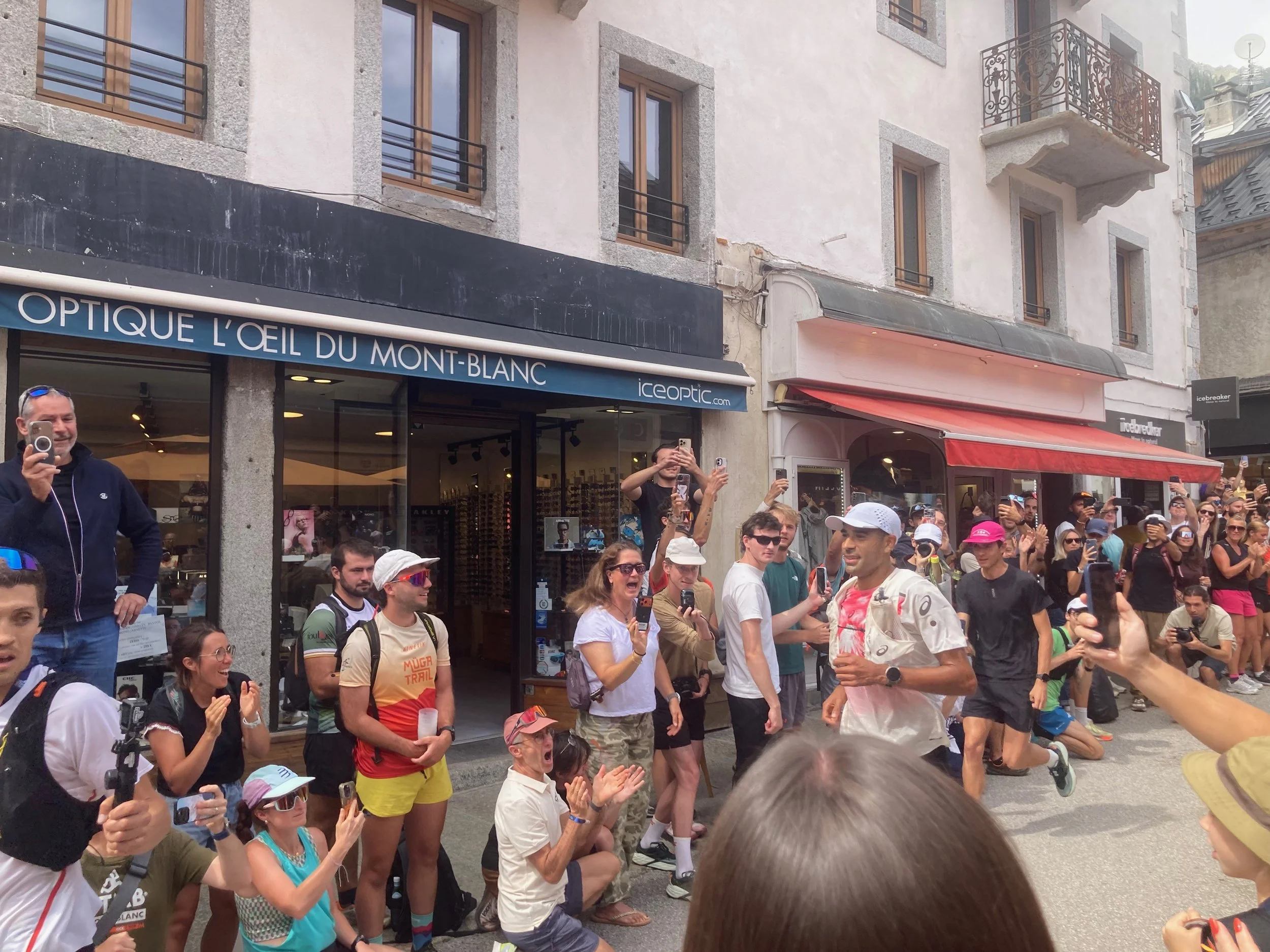
Ben Dhiman headed to the finish line of the UTMB 2026
To investigate, I analysed the top 50 male and female finishers from OCC, CCC and UTMB over the five editions from 2022 to 2026. Note that 2026 is still happening as I write so final positions need to be confirmed but are unlikely to change much.
That gives us:
3 races × 2 sexes × 5 years × 50 athletes = 1,500 performances. The results are fascinating and reveal some interesting trends.
The simple answer is that there is evidence of increasing competitive depth, but it isn't happening equally across every race or every field (over the past few years anyway).
One part of the sport, however, stands out.
Women's ultrarunning, and particularly the women's field at UTMB, appears to have undergone a remarkable transformation.
How I measured competitiveness
Comparing finishing times from one year to another isn't particularly useful in trail running. Courses change. Weather changes. Underfoot conditions change. Even relatively small route alterations can significantly influence finishing times. So rather, as is common, to compare winning times from year to the next, I only compared each year with itself. I calculated how far every athlete finished behind the winner of their race as a percentage of the winning time. For example, if the winner finished in 10 hours and another athlete finished in 11 hours, that athlete finished 10% behind the winner. A smaller percentage therefore indicates that the field was more tightly compressed around the winning performance.
There is an important caveat. This doesn't directly tell us that athletes are objectively getting faster or “better”. An exceptional winning performance can make everybody else appear further behind.
As a robustness check, I therefore repeated the analysis using the median performance of the top five athletes as the benchmark rather than the winner.
That becomes particularly important when interpreting some of the results.
OCC: no simple increase in competitiveness
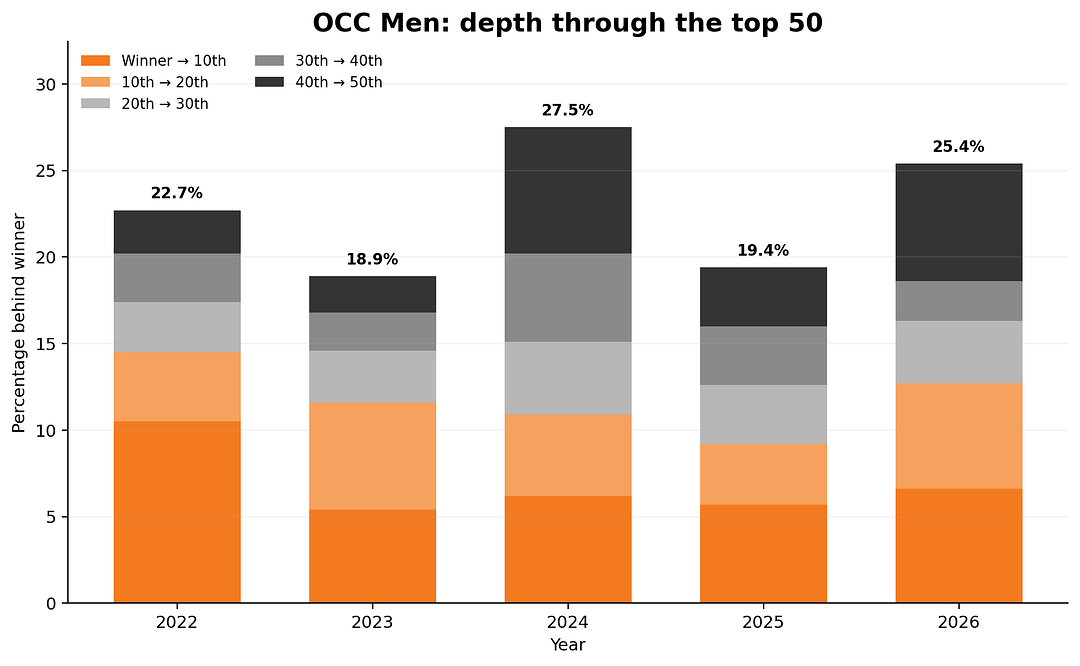
OCC provides perhaps the clearest warning against assuming that every elite trail field is becoming progressively deeper. At 50th place, the men's field was:
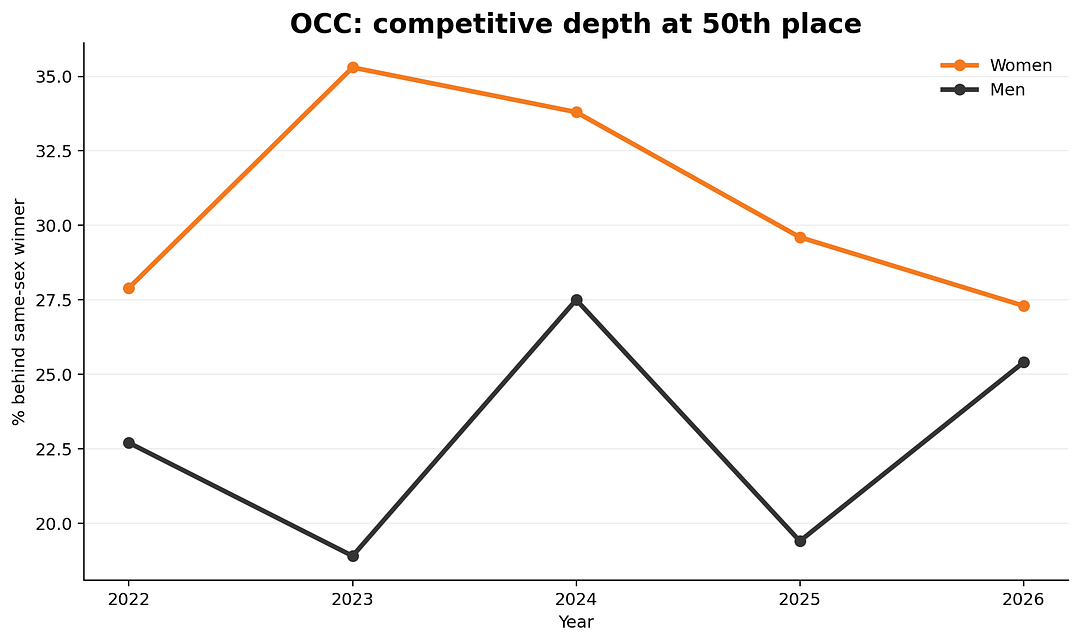
There is considerable year-to-year variation and no convincing five-year pattern towards a progressively tighter field. In fact, 50th place was 22.7% behind the winner in 2022 compared with 25.4% in 2026.
The women's race tells a similar story at this level. By 2026 the gap was almost identical to 2022. However since 2023 there has been a clear downward trend.
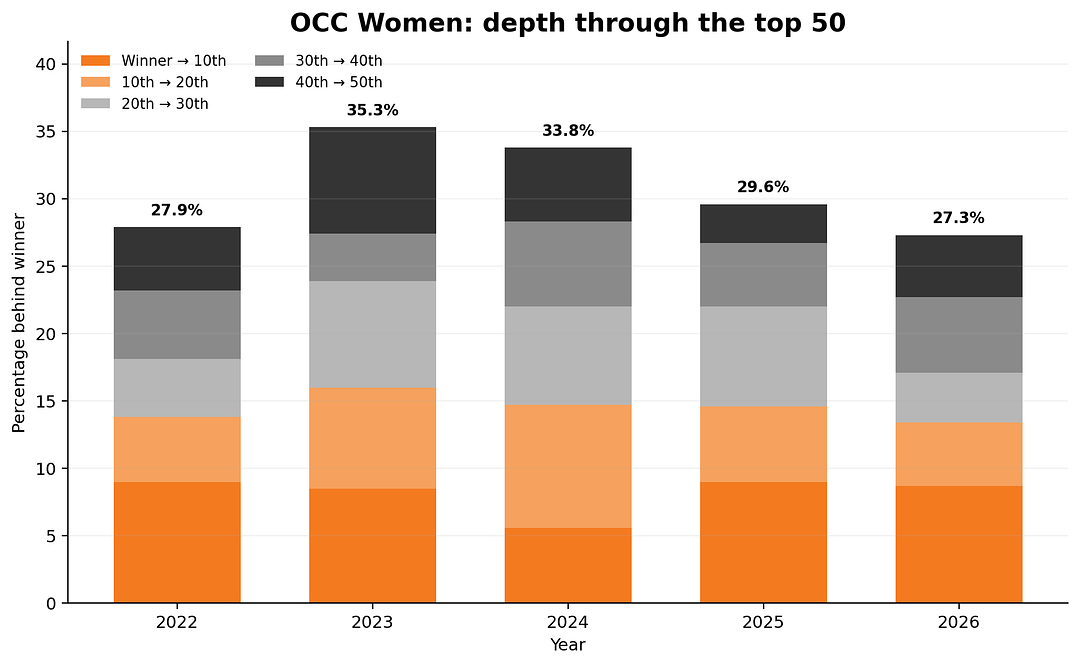
There are signs of changing depth within particular editions, and the 2026 women's field was notably compressed through much of the top 50 compared with the previous few years, but the five-year picture does not support a straightforward claim that OCC has simply become more competitive every year.
That is an important finding in itself. Looking at 10th, 20th, 30th and 40th as well as 50th as a percent of time you can see the shift from year to year.
Training for the OCC next year? We have dedicated training plans you can download and use directly through TrainingPeaks:
CCC: stronger evidence of increasing depth
CCC produces a different picture.
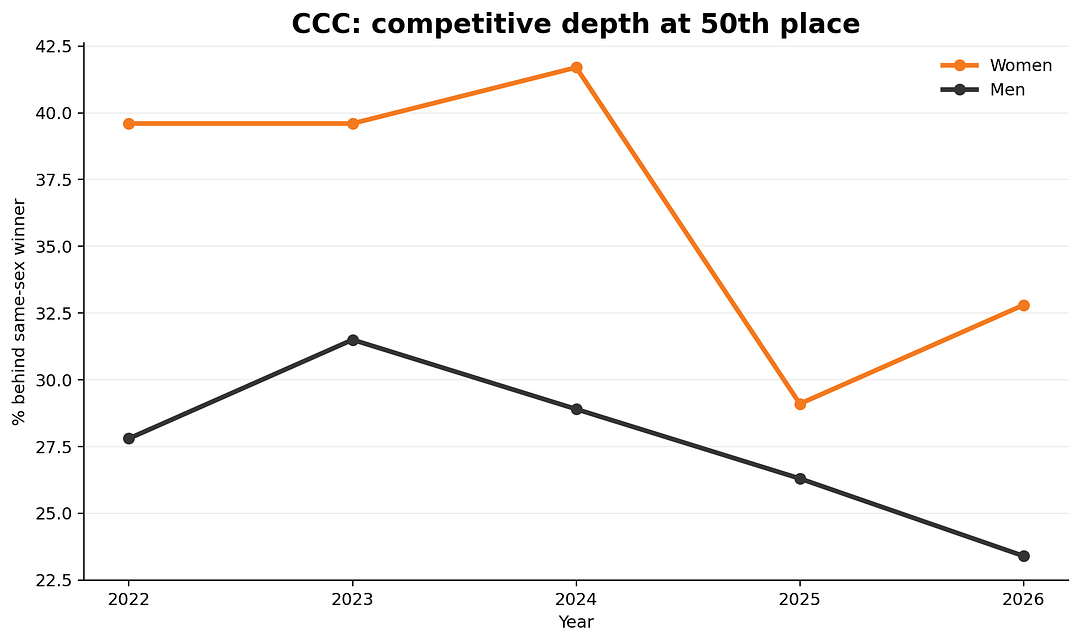
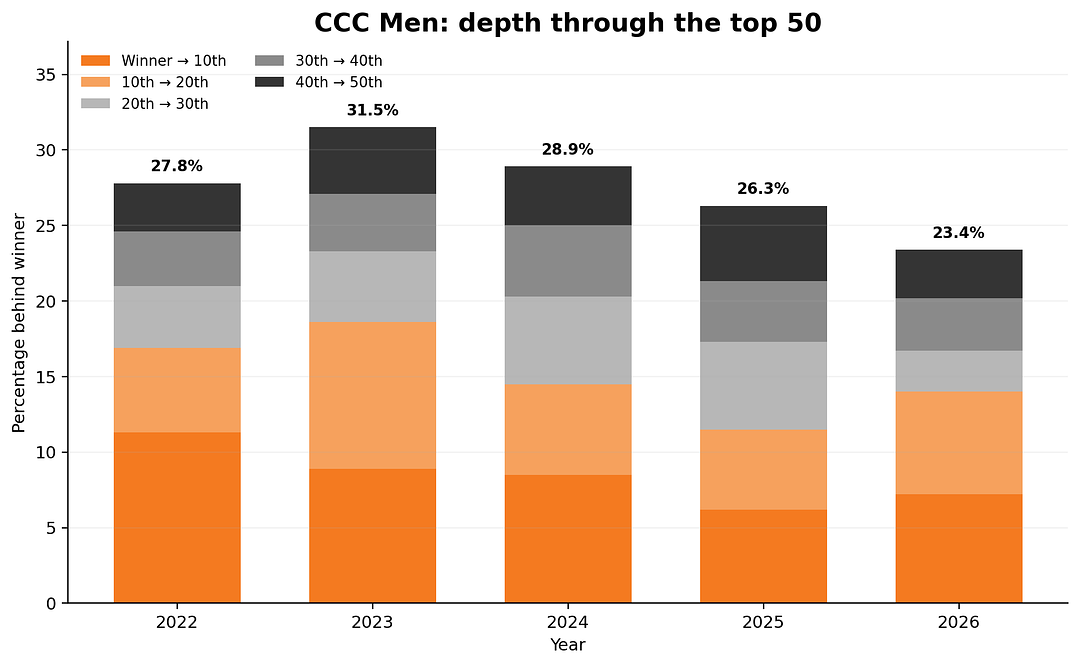
Among the men, 50th place moved from 27.8% behind the winner in 2022 to 23.4% in 2026.
What is particularly interesting here is what has happened deeper into the field. In 2022, 42 men finished within 25% of the winner. By 2026, all of the top 50 did. The front of the field hasn't changed nearly as dramatically. Instead, there appears to have been a compression of the athletes further down the top 50.
The CCC women's field
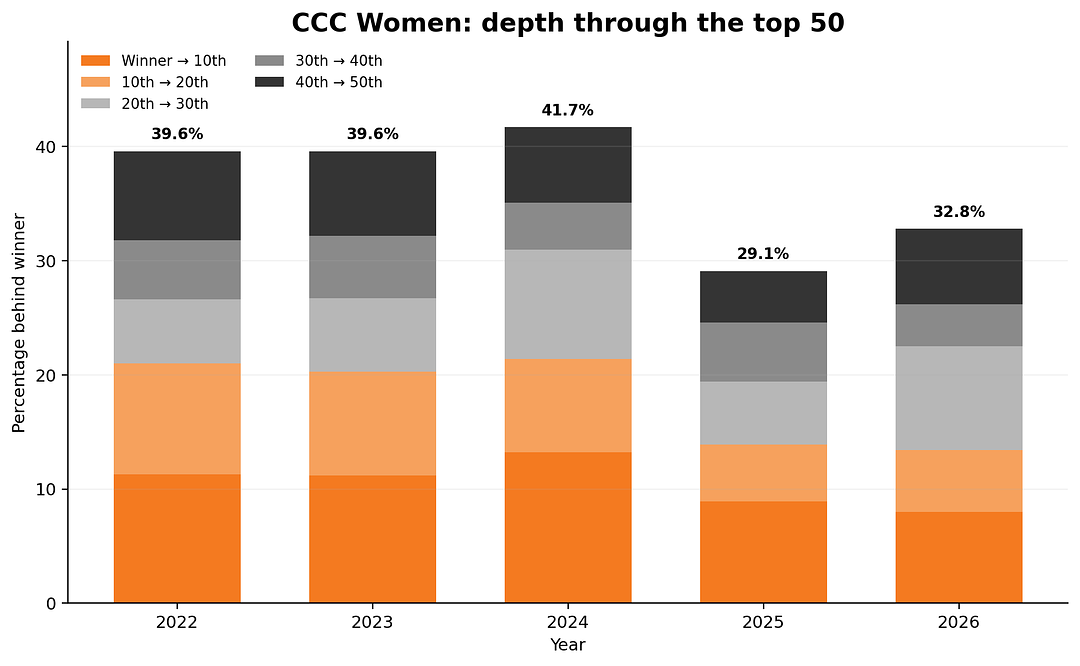
The women's data also suggest increasing depth, although again it isn't linear.
At 50th place:
2022: 39.6% behind the winner
2023: 39.6%
2024: 41.7%
2025: 29.1%
2026: 32.8%
The striking change appears from 2025 onwards. The gap from winner to 50th was around 40% across 2022–2024 before falling substantially in the last two editions.
The number of women within 25% of the winner tells a similar story:
25 in 2022 → 27 in 2023 → 25 in 2024 → 40 in 2025 → 36 in 2026.
So although 2026 was slightly less compressed than 2025, the last two editions look markedly different from the first three.
Train for CCC with a dedicated TrainingPeaks training plan featuring race advice & top tips from athletes’ experience:
UTMB men: remarkably stable
Perhaps one of the most surprising findings comes from the men's UTMB.
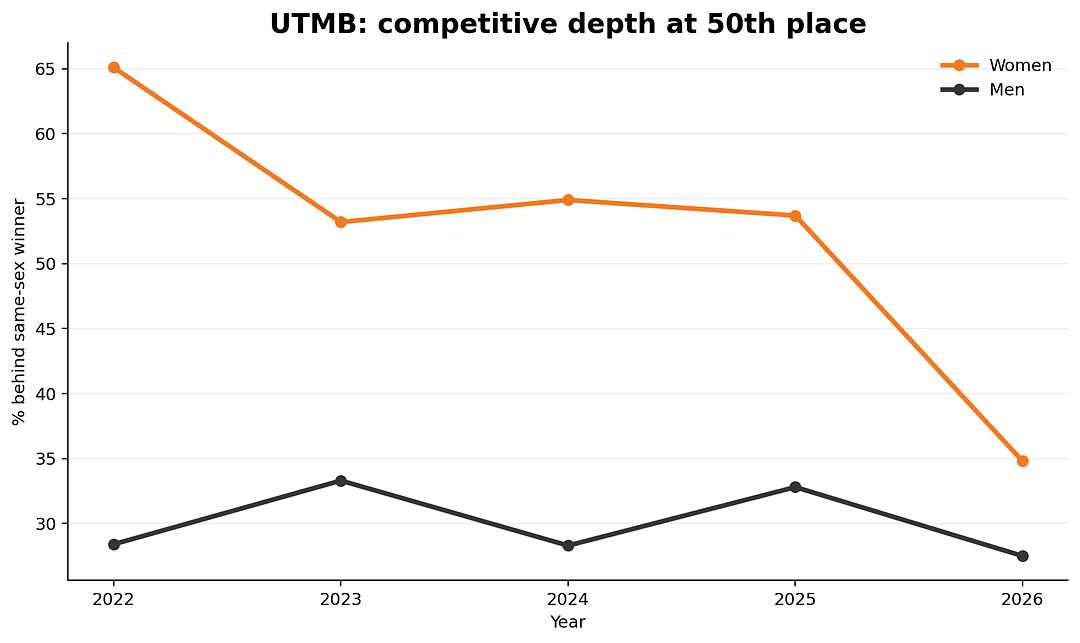
Given the growth and professionalisation of trail running, I expected the men's top 50 to show a clear compression over five years.
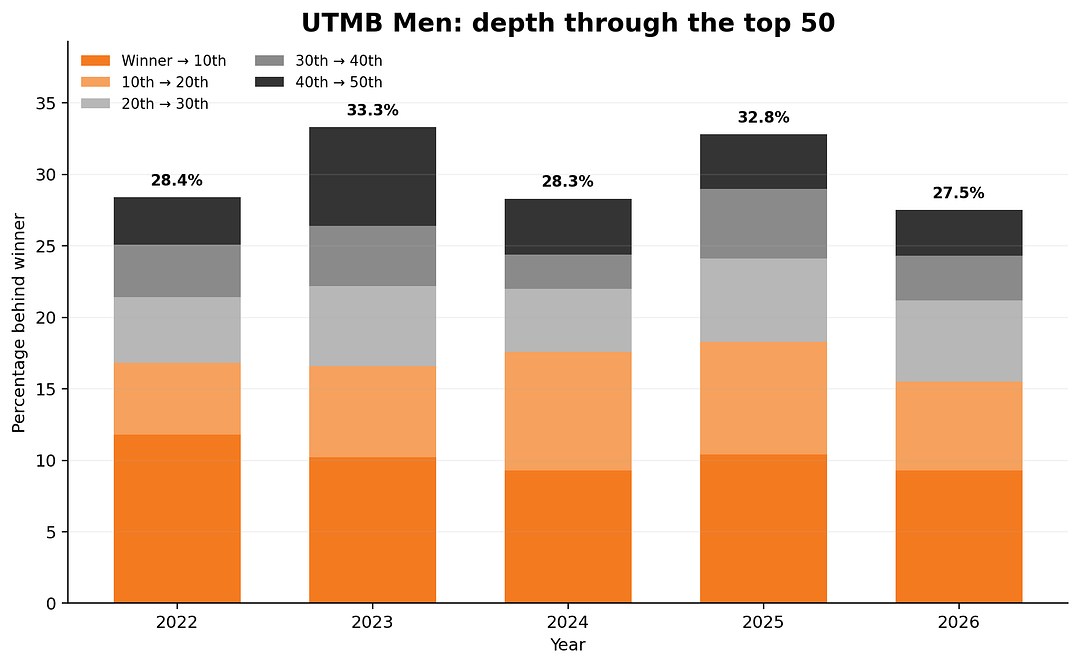
It doesn't. At 50th place, the gap was 28.4% in 2022 and 27.5% in 2026. Almost no change. There are fluctuations between editions, but there isn't a clear progressive compression of the field.
The top-five benchmark strengthens this interpretation. When I remove some of the influence of an exceptional individual winner by comparing 50th with the median performance of the first five athletes, the difference between 2022 and 2026 is effectively negligible.
So, at least using this measure, the men's UTMB field isn't obviously becoming dramatically deeper. That doesn't mean the athletes aren't improving. But relative to the athletes winning UTMB, the depth through the men's top 50 has remained surprisingly stable. Perhaps due to the depth the race has always attracted in recent editions.
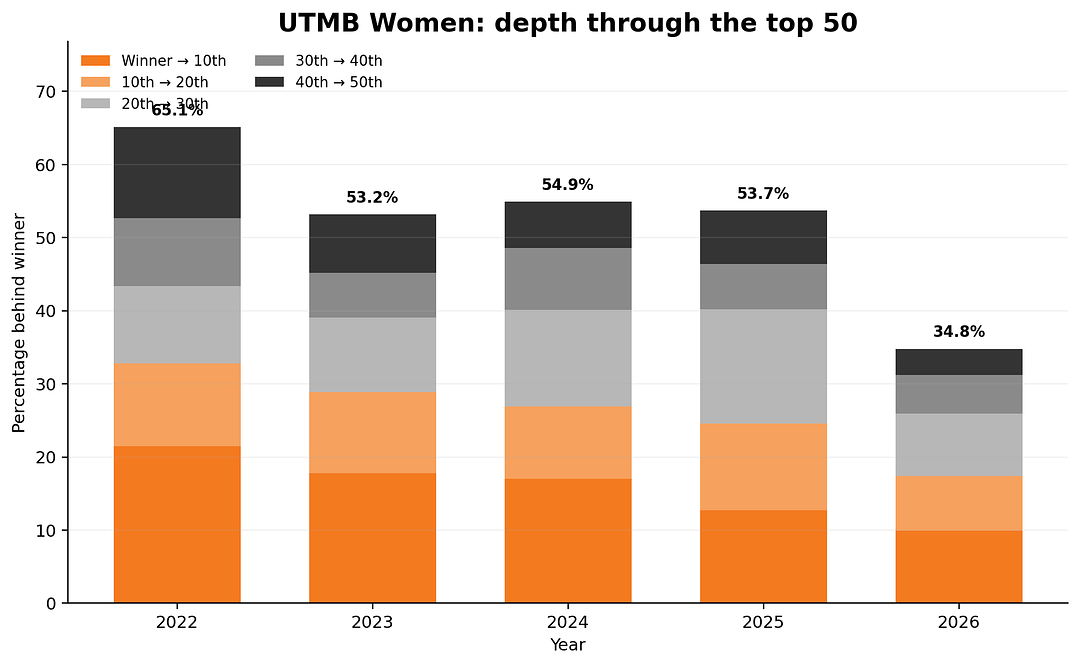
Then there is the women's UTMB. This is where the data change completely. The percentage gap between the women's winner and 50th place shows a huge change.
In 2022, the 50th woman finished 65.1% behind the winner. In 2026, she was 34.8% behind. That represents a reduction of more than 30 percentage points in just five editions. And it isn't simply caused by comparing everybody with one unusually fast or slow winner. When the median of the top five is used instead, the gap to 50th still falls by around 20 percentage points between 2022 and 2026. So the underlying conclusion remains.
When we look at the number of women close to the winner, it is perhaps an even easier way to understand the change. When we count how many women finished within a given percentage of the winning performance we can see that within 10% of the winner there are:
2022: 3
2023: 7
2024: 4
2025: 9
2026: 10
Within 20%:
2022: 9
2023: 11
2024: 11
2025: 13
2026: 20
And within 25%:
2022: 13
2023: 17
2024: 17
2025: 17
2026: 33
In 2022, only 13 of the first 50 women were within 25% of the winning time. In 2026 there were 33. More than two and a half times as many.
This isn't simply the front three or four women getting closer together, the whole competitive field is filling in behind them.
Is women's trail running catching up? This may be the most interesting question raised by the analysis. Historically, the women's fields at major ultras have generally shown much larger gaps than the men's fields. You can see that clearly in the 2022 UTMB data. The men's 50th-place finisher was 28.4% behind the men's winner. The women's 50th-place finisher was 65.1% behind the women's winner.
I think this reflects the depth of the respective competitive fields.
By 2026:
Men: 27.5%
Women: 34.8%
The gap between the depth of the men's and women's fields has therefore narrowed dramatically.
But this analysis can't tell us which of those explanations is responsible.
So, is elite trail running getting more competitive?
The answer depends on what we mean by competitive. I have previously done analysis on winning speeds (and these are getting faster). You can see the winning speeds of certain races below:
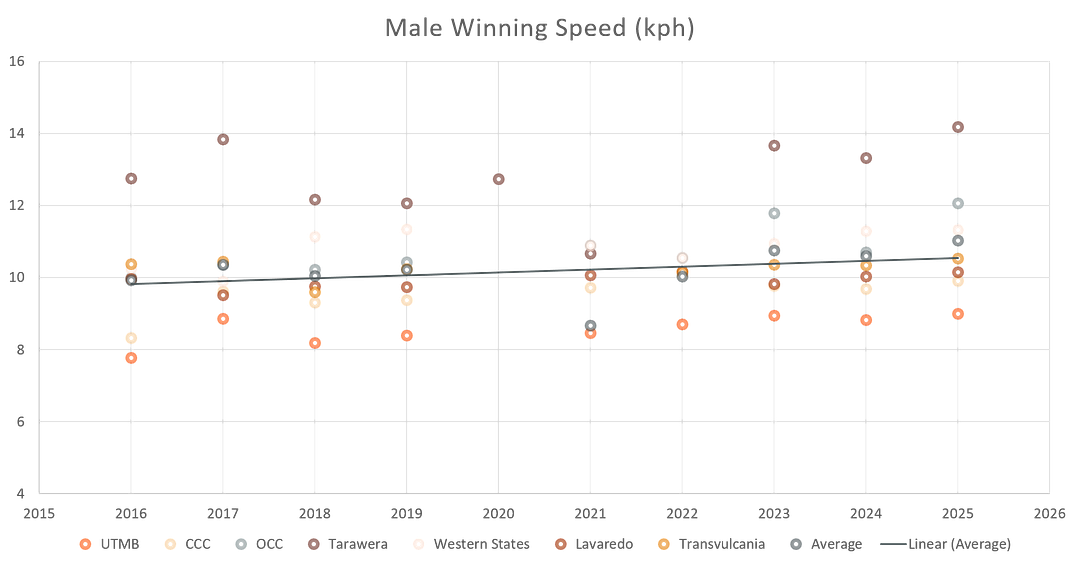
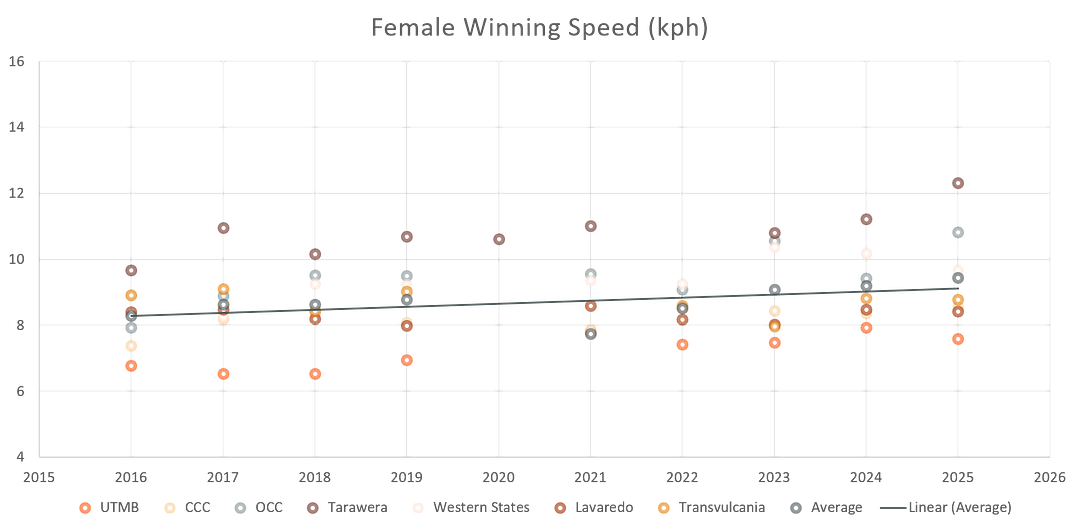
However if we look at depth and ask “Are the top 50 getting progressively closer to the winner in every major race?” Then the answer is not as clear looking at the UTMB finals. The data don't support that. The OCC men's results fluctuate considerably. OCC women’s results show no substantial change between the start and end of the period. The men's UTMB field is remarkably stable. But there are clear pockets of increasing competitive depth based on the data I included.
CCC has become more compressed, particularly deeper into the men's field and across the women's field in the last two editions. And the women's UTMB field has undergone a very substantial change.
A useful summary is the change in the gap between the winner and 50th place from 2022 to 2026:
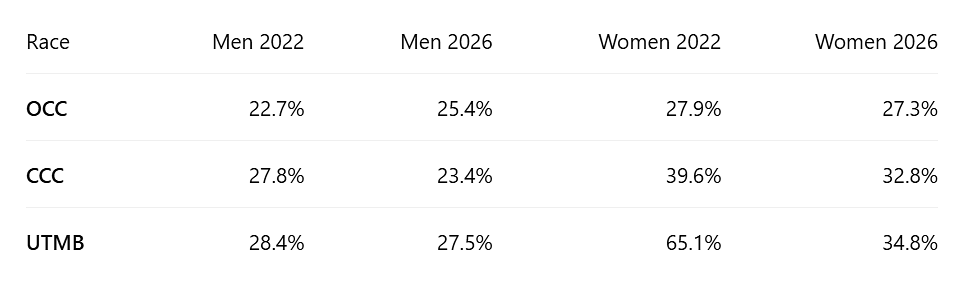
That table probably captures the main finding better than anything else. There isn't one universal trend towards greater competitiveness. Instead, different parts of elite trail running appear to be developing at different rates.
Trail running unquestionably feels more professional than it did five years ago, and the winners are running faster. So although 50th place may not be faster compared to the winning time (it is still slower by the same percentage as several years ago), it does mean 50th place is still running faster. And in certain races - like the women’s UTMB - the competitiveness has increased as well. Women's ultrarunning appears to be experiencing a particularly rapid increase in competitive depth. If this trajectory continues, the competitive landscape of elite women's ultrarunning five years from now could look very different again.
Like any analysis there are always limitations - I am sure if I had looked at top 100 finishers or the average finishing time versus the winners’ times for example we would have got very different results. But hopefully this provides some interesting insights into the front of the pack at the UTMB finals.
Is the UTMB your goal for next year?
We have dedicated training plans for the race: